经 AI Skill Hub 精选评估,sagents 获评「推荐使用」。这款Agent工作流在功能完整性、社区活跃度和易用性方面表现出色,AI 评分 7.5 分,适合有一定技术背景的用户使用。
📚 深度解析
sagents 工作流的设计遵循"最小配置,最大复用"原则:核心逻辑已经封装好,用户只需配置自己的 API Key 和业务参数即可快速上手。工作流内置错误处理和重试机制,在网络波动或 API 限速等情况下仍能稳定运行,适合作为生产环境的自动化基础设施。
在实际部署时,建议先在测试环境中运行 3-5 次,验证各个环节的输出结果符合预期,再部署到生产环境。AI Skill Hub 评分 7.5 分,是同类 Agent 工作流中的精选推荐。
📋 工具概览
基于Elixir的OTP监督和中间件组合,构建交互式AI代理
sagents 是一套完整的 AI Agent 自动化工作流方案。通过可视化的节点编排,将复杂的多步骤任务拆解为清晰的自动化流程,实现全程无人值守的智能处理。支持与数百种外部服务和 API 无缝集成,适合构建数据处理管线、业务自动化和 AI 辅助决策系统。
📖 中文文档
基于Elixir的OTP监督和中间件组合,构建交互式AI代理
sagents 是一套完整的 AI Agent 自动化工作流方案。通过可视化的节点编排,将复杂的多步骤任务拆解为清晰的自动化流程,实现全程无人值守的智能处理。支持与数百种外部服务和 API 无缝集成,适合构建数据处理管线、业务自动化和 AI 辅助决策系统。
- 可视化 Agent 工作流编排,无需编写复杂代码
- 支持多步骤自动化任务链,实现全流程无人值守
- 与外部 API、数据库和第三方服务无缝集成
- 内置错误处理与自动重试机制,保障稳定运行
- 提供可复用的自动化模板,快速在同类场景部署
- 自动化日常重复性工作,将精力集中于创造性任务
- 构建数据采集 → 处理 → 输出的完整自动化管线
- 实现跨平台、跨系统的数据流转和业务协同
# 克隆仓库
git clone https://github.com/sagents-ai/sagents
cd sagents

# 查看安装说明
cat README.md

# 按 README 完成环境依赖安装后即可使用
- 访问 GitHub 仓库获取工作流文件
- 在对应平台(Dify / Flowise / Make 等)中找到「导入工作流」功能
- 上传工作流文件
- 按照提示配置必要的环境变量和 API Key
- 运行测试确认流程正常后投入使用
# 查看帮助
sagents --help

# 基本运行
sagents [options] <input>

# 详细使用说明请查阅文档
# https://github.com/sagents-ai/sagents
# sagents 配置说明
# 查看配置选项
sagents --config-example > config.yml

# 常见配置项
# output_dir: ./output
# log_level: info
# workers: 4

# 环境变量(覆盖配置文件)
export SAGENTS_CONFIG="/path/to/config.yml"
Sagents
Sage Agents - Combining the wisdom of a Sage) with the power of LLM-based Agents
A sage is a person who has attained wisdom and is often characterized by sound judgment and deep understanding. Sagents brings this philosophy to AI agents: building systems that don't just execute tasks, but do so with thoughtful human oversight, efficient resource management, and extensible architecture.
Key Features
- Human-In-The-Loop (HITL) - Customizable permission system that pauses execution for approval on sensitive operations, including parallel tool calls where each action can be individually approved/rejected. Works across both main agents and SubAgents — interrupts propagate up to the parent for approval and resume seamlessly
- Composable Execution Modes - Agent run loops are explicit Elixir pipelines built from reusable steps. Mix and match built-in steps (
call_llm,execute_tools,check_pre_tool_hitl,propagate_state, etc.) or write your own. Different agents can use different modes in the same application - Structured Agent Completion (
until_tool) - Force agents to loop until they call a specific tool, returning the result as a clean{:ok, state, %ToolResult{}}tuple. No more hoping the LLM follows your output format — get structured data you can pattern match on - SubAgents - Delegate complex tasks to specialized child agents for efficient context management and parallel execution
- GenServer Architecture - Each agent runs as a supervised OTP process with automatic lifecycle management
- Phoenix.Presence Integration - Smart resource management that knows when to shut down idle agents
- PubSub Real-Time Events - Stream agent state, messages, and events to multiple LiveView subscribers
- Middleware System - Extensible plugin architecture for adding capabilities to agents, including composable observability callbacks for OpenTelemetry, metrics, or custom logging
- Cluster-Aware Distribution - Optional Horde-based distribution for running agents across a cluster of nodes with automatic state migration, or run locally on a single node (the default)
- State Persistence - Save and restore agent conversations via optional behaviour modules for agent state and display messages
- Virtual Filesystem - Isolated, in-memory file operations with optional persistence
See it in action! Try the agents_demo application to experience Sagents interactively, or add the sagents_live_debugger to your app for real-time insights into agent configuration, state, and event flows.
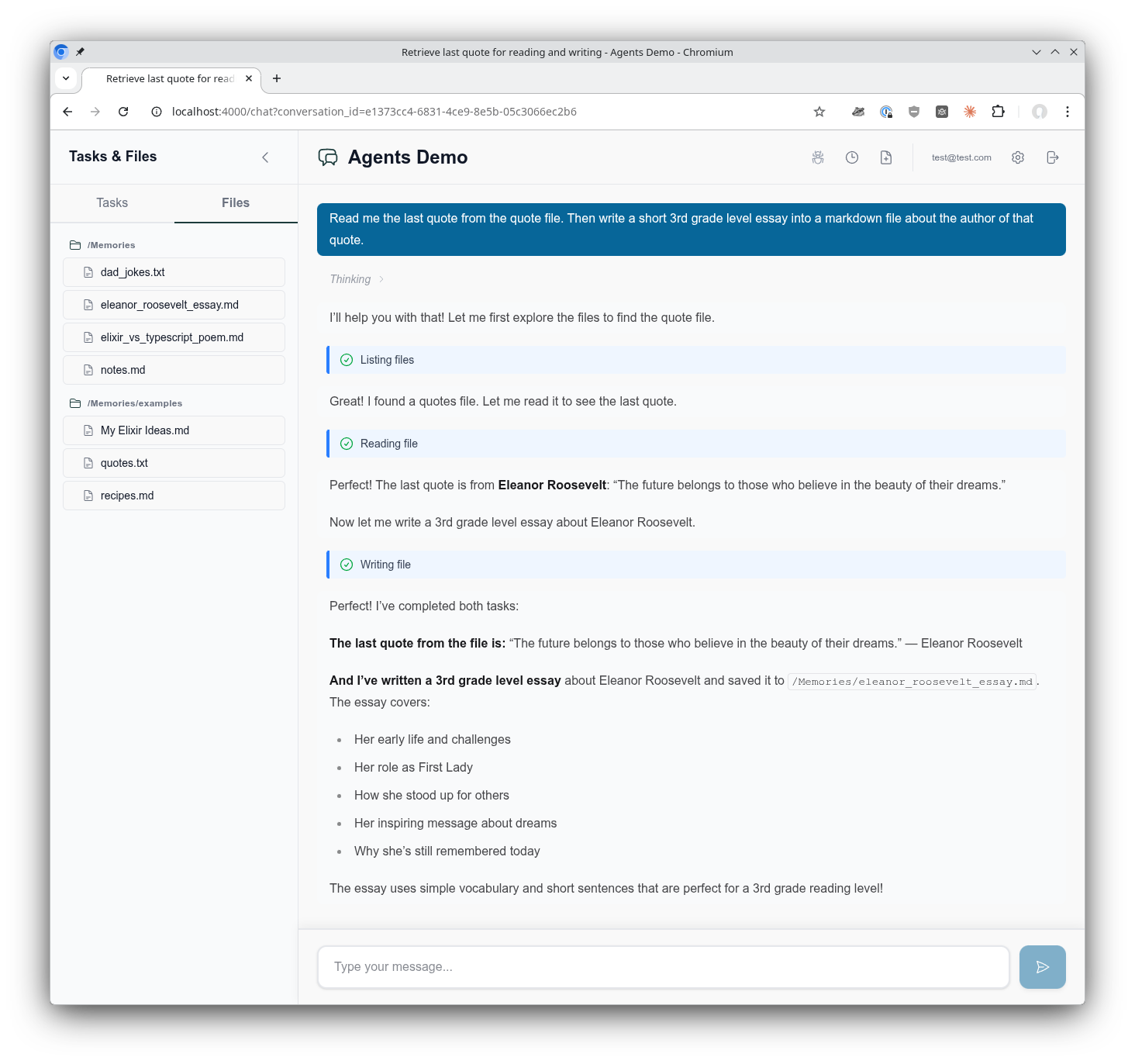
The AgentsDemo chat interface showing the use of a virtual filesystem, tool call execution, composable middleware, supervised Agentic GenServer assistant, and much more!
Create agent with middleware capabilities
{:ok, agent} = Agent.new(%{ agent_id: "my-agent-1", model: ChatAnthropic.new!(%{model: "claude-sonnet-4-5-20250929"}), base_system_prompt: "You are a helpful coding assistant.", middleware: [ TodoList, FileSystem, {HumanInTheLoop, [ interrupt_on: %{ "write_file" => true, "delete_file" => true } ]} ] }) ```
Install dependencies
mix deps.get
Run tests with live API calls (requires API keys, incurs costs)
mix test --include live_call mix test --include live_anthropic
Installation
Add sagents to your list of dependencies in mix.exs:
def deps do
  [
    {:sagents, "~> 0.7.0"}
  ]
end
LangChain is automatically included as a dependency.
Supervision Tree Setup
Add Sagents.Supervisor to your application's supervision tree:
```elixir
Quick Setup
Sagents provides generators to scaffold everything you need for conversation-centric agents:
mix sagents.setup MyApp.Conversations \
  --scope MyApp.Accounts.Scope \
  --owner-type user \
  --owner-field user_id
This generates: - Persistence layer - Database schemas and migration - Factory module - Agent creation with model/middleware configuration - Coordinator module - Session management and lifecycle orchestration
All configured to work together seamlessly based on your --owner-type and --owner-field settings.
Quick Start
Usage Pattern
```elixir
agents_demo
A complete Phoenix LiveView application demonstrating Sagents in action: - Multi-conversation support with real-time state persistence - Human-in-the-loop approval workflows - File system operations with persistence - SubAgent delegation patterns
Configuration
Sagents builds on the Elixir LangChain library for LLM integration. To use Sagents, you need to configure an LLM provider by setting the appropriate API key as an environment variable:
```bash
Advanced Options
mix sagents.setup MyApp.Conversations \
  --scope MyApp.Accounts.Scope \
  --owner-type user \
  --owner-field user_id \
  --factory MyApp.Agents.Factory \
  --coordinator MyApp.Agents.Coordinator \
  --pubsub MyApp.PubSub \
  --presence MyAppWeb.Presence \
  --table-prefix sagents_
All options have sensible defaults based on your context module and Phoenix conventions.
For a fully customized example, see the agents_demo project.
config/config.exs
config :sagents, :distribution, :horde ```
When Horde is enabled, Sagents.ProcessRegistry and Sagents.ProcessSupervisor automatically switch to Horde.Registry and Horde.DynamicSupervisor, giving you:
- Automatic agent redistribution across cluster nodes
- State migration when nodes join or leave the cluster
- Regional clustering for Fly.io deployments via
Sagents.Horde.ClusterConfig - Node transfer events broadcast during redistribution so your UI can react
Agents broadcast {:agent, {:node_transferring, data}} and {:agent, {:node_transferred, data}} events during Horde redistribution, allowing connected clients to follow their agent to a new node.
No code changes are needed beyond the config — the ProcessRegistry and ProcessSupervisor abstractions handle backend switching transparently.
sagents是一个开源的AI工作流项目,使用Elixir和OTP监督,提供了一个灵活的中间件组合,用于构建交互式AI代理。虽然项目质量较高,但仍需要进一步的测试和优化。
- 构建多智能体协作系统的 Agent 开发者
- Agent 任务先做 dry-run 验证工具调用链,再开启自主执行
- API key 直接提交到 git 仓库(请用 .env 并加入 .gitignore)
- 云端托管:可放在 Vercel / Railway / Fly.io 等 PaaS 平台
⚡ 核心功能
- 可视化 Agent 工作流编排,无需编写复杂代码
- 支持多步骤自动化任务链,实现全流程无人值守
- 与外部 API、数据库和第三方服务无缝集成
- 内置错误处理与自动重试机制,保障稳定运行
- 提供可复用的自动化模板,快速在同类场景部署
- 构建多智能体协作系统的 Agent 开发者
- Agent 任务先做 dry-run 验证工具调用链,再开启自主执行
- API key 直接提交到 git 仓库(请用 .env 并加入 .gitignore)
👥 适合人群
🎯 使用场景
- 自动化日常重复性工作,将精力集中于创造性任务
- 构建数据采集 → 处理 → 输出的完整自动化管线
- 实现跨平台、跨系统的数据流转和业务协同
⚖️ 优点与不足
- +大幅减少重复性人工操作
- +可视化流程,清晰直观
- +可扩展性强,支持复杂场景
- −初始配置和调试需投入一定时间
- −强依赖外部服务的稳定性
- −复杂场景需具备一定技术基础
该工具使用 NOASSERTION 协议,商用场景请仔细阅读协议条款,必要时咨询法律意见。
AI Skill Hub 为第三方内容聚合平台,本页面信息基于公开数据整理,不对工具功能和质量作任何法律背书。
建议在沙箱或测试环境中充分验证后,再部署至生产环境,并做好必要的安全评估。
📄 NOASSERTION — 请查阅原始协议条款了解具体使用限制。
🔗 相关工具推荐
❓ 常见问题 FAQ
AI Skill Hub 点评:sagents 的核心功能完整,质量良好。对于自动化工程师和运维人员来说,这是一个值得纳入个人工具库的选择。建议先在非生产环境试用,再逐步推广。
| 原始名称 | sagents |
| 原始描述 | 开源AI工作流:Build interactive AI agents in Elixir with OTP supervision, middleware compositi。⭐226 · Elixir |
| Topics | workflowagentaielixir |
| GitHub | https://github.com/sagents-ai/sagents |
| License | NOASSERTION |
| 语言 | Elixir |
收录时间:2026-06-09 · 更新时间:2026-06-09 · License:NOASSERTION · AI Skill Hub 不对第三方内容的准确性作法律背书。