
智能代理工作流
经 AI Skill Hub 精选评估,智能代理工作流 获评「推荐使用」。这款Agent工作流在功能完整性、社区活跃度和易用性方面表现出色,AI 评分 7.5 分,适合有一定技术背景的用户使用。
📚 深度解析
智能代理工作流 工作流的设计遵循"最小配置,最大复用"原则:核心逻辑已经封装好,用户只需配置自己的 API Key 和业务参数即可快速上手。工作流内置错误处理和重试机制,在网络波动或 API 限速等情况下仍能稳定运行,适合作为生产环境的自动化基础设施。
在实际部署时,建议先在测试环境中运行 3-5 次,验证各个环节的输出结果符合预期,再部署到生产环境。AI Skill Hub 评分 7.5 分,是同类 Agent 工作流中的精选推荐。
📋 工具概览
智能代理工作流 是一套完整的 AI Agent 自动化工作流方案。通过可视化的节点编排,将复杂的多步骤任务拆解为清晰的自动化流程,实现全程无人值守的智能处理。支持与数百种外部服务和 API 无缝集成,适合构建数据处理管线、业务自动化和 AI 辅助决策系统。
📖 中文文档
智能代理工作流 是一套完整的 AI Agent 自动化工作流方案。通过可视化的节点编排,将复杂的多步骤任务拆解为清晰的自动化流程,实现全程无人值守的智能处理。支持与数百种外部服务和 API 无缝集成,适合构建数据处理管线、业务自动化和 AI 辅助决策系统。
- 可视化 Agent 工作流编排,无需编写复杂代码
- 支持多步骤自动化任务链,实现全流程无人值守
- 与外部 API、数据库和第三方服务无缝集成
- 内置错误处理与自动重试机制,保障稳定运行
- 提供可复用的自动化模板,快速在同类场景部署
- 自动化日常重复性工作,将精力集中于创造性任务
- 构建数据采集 → 处理 → 输出的完整自动化管线
- 实现跨平台、跨系统的数据流转和业务协同
# 方式一:cargo install(推荐)
cargo install symbiont

# 方式二:从源码编译
git clone https://github.com/ThirdKeyAI/Symbiont
cd Symbiont
cargo build --release
# 二进制在 ./target/release/symbiont
- 访问 GitHub 仓库获取工作流文件
- 在对应平台(Dify / Flowise / Make 等)中找到「导入工作流」功能
- 上传工作流文件
- 按照提示配置必要的环境变量和 API Key
- 运行测试确认流程正常后投入使用
# 查看帮助
symbiont --help

# 基本运行
symbiont [options] <input>

# 详细使用说明请查阅文档
# https://github.com/ThirdKeyAI/Symbiont
# symbiont 配置说明
# 查看配置选项
symbiont --config-example > config.yml

# 常见配置项
# output_dir: ./output
# log_level: info
# workers: 4

# 环境变量(覆盖配置文件)
export SYMBIONT_CONFIG="/path/to/config.yml"
简介
<img src="https://raw.githubusercontent.com/ThirdKeyAI/Symbiont/main/logo-hz.png" alt="Symbi">
中文简体 | Español | Português | 日本語 | Deutsch








---
Policy-governed agent runtime for production. Same agent. Secure runtime.
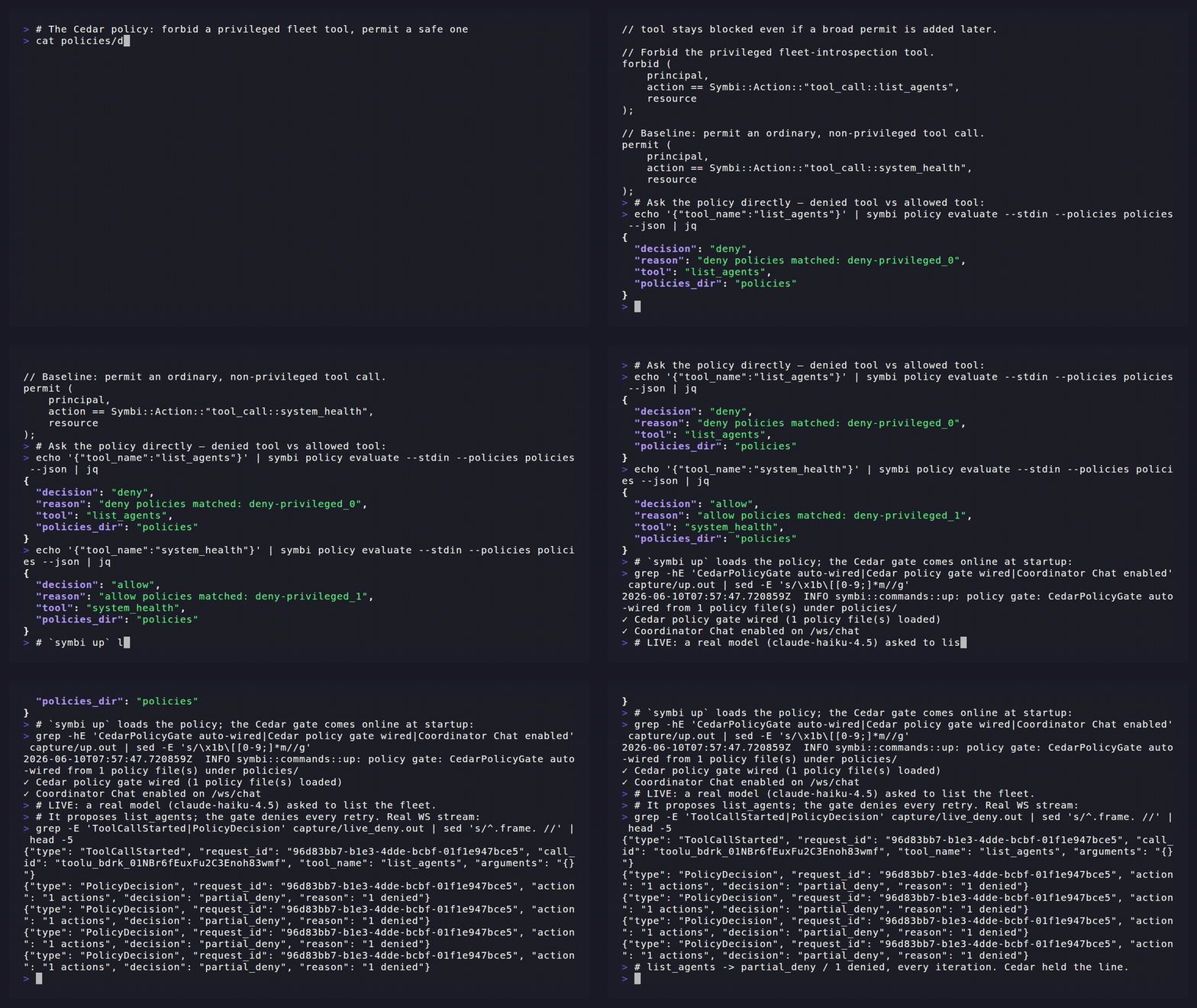
What you're seeing: a real model (claude-haiku-4.5) asks to list the agent fleet. A Cedarforbidrule denies the call on every retry — no code change, just policy. Reproduce it in one command ↓ · ▶ Full walkthrough
Symbiont is a Rust-native runtime for executing AI agents and tools under explicit policy, identity, and audit controls.
Most agent frameworks focus on orchestration. Symbiont focuses on what happens when agents need to run in real environments with real risk: untrusted tools, sensitive data, approval boundaries, audit requirements, and repeatable enforcement.
---
Core capabilities
| Capability | What it does |
|---|---|
| **Policy engine** | Fine-grained [Cedar](https://www.cedarpolicy.com/) authorization for agent actions, tool calls, and resource access |
| **Tool verification** | [SchemaPin](https://github.com/ThirdKeyAI/SchemaPin) cryptographic verification of MCP tool schemas before execution |
| **Tool contracts** | [ToolClad](https://github.com/ThirdKeyAI/ToolClad) declarative contracts with argument validation, scope enforcement, and Cedar policy generation |
| **Agent identity** | [AgentPin](https://github.com/ThirdKeyAI/AgentPin) domain-anchored ES256 identity for agents and scheduled tasks |
| **Reasoning loop** | Typestate-enforced Observe-Reason-Gate-Act cycle with policy gates and circuit breakers |
| **Sandboxing** | Docker, gVisor (runsc), or Firecracker microVM — selectable per agent via the DSL with { sandbox = ... } block |
| **Audit logging** | Tamper-evident logs with structured records for every policy decision |
| **Secrets management** | Vault/OpenBao integration, AES-256-GCM encrypted storage, scoped per agent |
| **MCP integration** | Native Model Context Protocol support with governed tool access |
Additional capabilities: threat scanning for tool/skill content (40 rules, 10 attack categories), cron scheduling, persistent agent memory, hybrid RAG search (LanceDB/Qdrant), webhook verification, delivery routing, OTLP telemetry, HTTP security hardening, and governance plugins for Claude Code and Gemini CLI. See the full documentation for details.
Representative benchmarks are available in the benchmark harness and threshold tests.
---
Prerequisites
- Docker (recommended) or Rust 1.82+
See the policy gate deny a tool — one command, no setup
A Cedar forbid blocks a privileged tool while a safe one passes. Copy-paste this against the published image (no clone, no build):
docker run --rm --entrypoint sh ghcr.io/thirdkeyai/symbi:latest -c '
mkdir -p /tmp/p && cat > /tmp/p/policy.cedar <<EOF
forbid(principal, action == Symbi::Action::"tool_call::list_agents",   resource);
permit(principal, action == Symbi::Action::"tool_call::system_health", resource);
EOF
echo "{\"tool_name\":\"list_agents\"}"   | symbi policy evaluate --stdin --policies /tmp/p --json
echo "{\"tool_name\":\"system_health\"}" | symbi policy evaluate --stdin --policies /tmp/p --json'
{"decision":"deny","reason":"deny policies matched: policy_0","tool":"list_agents", ...}
{"decision":"allow","reason":"allow policies matched: policy_1","tool":"system_health", ...}That's the same Cedar gate the runtime wires into the live reasoning loop — exactly the denial shown in the demo above.
Install the CLI
```bash
Linux / macOS — installs the `symbi` binary to /usr/local/bin
curl -fsSL https://symbiont.dev/install.sh | bash symbi --help ```
The installer fetches the prebuilt release binary for your platform. Pin a version with bash -s -- --version v1.15.2 or change the target with --dir. Prefer Docker or building from source? Both are below.
Scaffold and run a project (Docker, ~60 seconds)
```bash
Generates symbiont.toml, agents/, policies/, docker-compose.yml, and
Other Docker recipes
```bash
Build from source
```bash cargo build --release ./target/release/symbi --help
Quick start
Example: untrusted tool blocked by policy
An agent attempts to call an unverified MCP tool. The runtime:
- Checks SchemaPin verification status — tool signature is missing or invalid
- Evaluates Cedar policy —
forbid(action == Action::"tool_call") when { !resource.verified } - Blocks execution and logs the denial with full context
- Optionally routes to an operator for manual approval
No code change required. The policy governs execution.
---
DSL example
agent secure_analyst(input: DataSet) -> Result {
    policy access_control {
        allow: read(input) if input.verified == true
        deny: send_email without approval
        audit: all_operations
    }

    with memory = "persistent", requires = "approval" {
        result = analyze(input);
        return result;
    }
}
See the DSL guide for the full grammar including metadata, schedule, webhook, and channel blocks.
File extension: Symbiont agent definitions use.symbias their canonical extension (e.g.agents/assistant.symbi). The legacy.dslextension continues to be parsed indefinitely for backward compatibility, but new projects scaffolded withsymbi initand all examples in this repo use.symbi.
---
a .env with a freshly generated SYMBIONT_MASTER_KEY.
docker run --rm -v $(pwd):/workspace ghcr.io/thirdkeyai/symbi:latest \ init --profile assistant --no-interact --dir /workspace
2. Start the runtime. Reads .env automatically.
docker compose up ```
That's it — Runtime API on http://localhost:8080, HTTP Input on http://localhost:8081. Use symbi init --catalog list (or the Docker equivalent) to browse pre-built agents.
Open Agent Trust Stack (OATS) — reference implementation
Symbiont is the reference implementation of the Open Agent Trust Stack (OATS) — an open specification (CC BY 4.0) for securing AI agent execution through structural enforcement rather than post-hoc interception ("define what is permitted and make everything else structurally inexpressible"). The OATS spec is grounded in Symbiont's production operational experience and Symbiont's design tracks the OATS layers directly:
| OATS Layer | Symbiont mapping |
|---|---|
| **Layer 1 — ORGA Loop** (typestate-enforced Observe-Reason-Gate-Act) | crates/runtime/src/reasoning/ — typestate-enforced phases; policy gate is unskippable at compile time. See [Wanger 2026 / DOI 10.5281/zenodo.19896446](https://doi.org/10.5281/zenodo.19896446). |
| **Layer 2 — Tool Contracts** | [ToolClad](https://github.com/ThirdKeyAI/ToolClad) declarative .clad.toml manifests + the agent_summary typestate fence in crates/runtime/src/toolclad/. See [Wanger 2026 / DOI 10.5281/zenodo.19957596](https://doi.org/10.5281/zenodo.19957596). |
| **Layer 3 — Identity** | [SchemaPin](https://github.com/ThirdKeyAI/SchemaPin) for MCP tools + [AgentPin](https://github.com/ThirdKeyAI/AgentPin) ES256 domain-anchored agent identity. |
| **Layer 4 — Policy Engine** | Cedar policy gate (crates/runtime/src/reasoning/cedar_gate.rs) + CommunicationPolicyGate for inter-agent calls; both fail-closed by default since v1.14.0. |
| **Layer 5 — Audit Journal** | Hash-chained, Ed25519-signed BufferedJournal in the reasoning loop; encrypted model-I/O logs in crates/runtime/src/logging.rs. |
Symbiont conforms to OATS Extended (C1–C7 + E1–E8). The empirical comparison of structural-enforcement runtimes that informs the spec is Wanger 2026 / DOI 10.5281/zenodo.20043247.
---
SDKs
Official client SDKs for integrating with the Symbiont runtime from your application:
| Language | Package | Repository |
|---|---|---|
| **JavaScript/TypeScript** | [symbiont-sdk-js](https://www.npmjs.com/package/symbiont-sdk-js) | [GitHub](https://github.com/ThirdKeyAI/symbiont-sdk-js) |
| **Python** | [symbiont-sdk](https://pypi.org/project/symbiont-sdk/) | [GitHub](https://github.com/ThirdKeyAI/symbiont-sdk-python) |
Production recommendation: The JS and Python SDKs are HTTP clients intended for application integration and prototyping. For production agent workloads, we recommend building directly on the Rust implementation to leverage Symbiont's full typestate-driven safety guarantees — capability authorization, policy enforcement, and lifecycle invariants enforced at compile time rather than runtime. Dynamic-language clients can only verify these properties after a request crosses the runtime boundary.
---
高质量的AI工作流项目
- 需要 Symbiont 解决具体问题的开发者与运营人员
- 先在测试环境跑通最小用例,再接入生产数据
- API key 直接提交到 git 仓库(请用 .env 并加入 .gitignore)
- 云端托管:可放在 Vercel / Railway / Fly.io 等 PaaS 平台
⚡ 核心功能
- 可视化 Agent 工作流编排,无需编写复杂代码
- 支持多步骤自动化任务链,实现全流程无人值守
- 与外部 API、数据库和第三方服务无缝集成
- 内置错误处理与自动重试机制,保障稳定运行
- 提供可复用的自动化模板,快速在同类场景部署
- 需要 Symbiont 解决具体问题的开发者与运营人员
- 先在测试环境跑通最小用例,再接入生产数据
- API key 直接提交到 git 仓库(请用 .env 并加入 .gitignore)
👥 适合人群
🎯 使用场景
- 自动化日常重复性工作,将精力集中于创造性任务
- 构建数据采集 → 处理 → 输出的完整自动化管线
- 实现跨平台、跨系统的数据流转和业务协同
⚖️ 优点与不足
- +Apache-2.0 协议,可免费商用
- +大幅减少重复性人工操作
- +可视化流程,清晰直观
- +可扩展性强,支持复杂场景
- −初始配置和调试需投入一定时间
- −强依赖外部服务的稳定性
- −复杂场景需具备一定技术基础
AI Skill Hub 为第三方内容聚合平台,本页面信息基于公开数据整理,不对工具功能和质量作任何法律背书。
建议在沙箱或测试环境中充分验证后,再部署至生产环境,并做好必要的安全评估。
✅ Apache 2.0 — 宽松开源协议,可商用,需保留版权声明和 NOTICE 文件,含专利授权条款。
🔗 相关工具推荐
❓ 常见问题 FAQ
AI Skill Hub 点评:智能代理工作流 的核心功能完整,质量良好。对于自动化工程师和运维人员来说,这是一个值得纳入个人工具库的选择。建议先在非生产环境试用,再逐步推广。
| 原始名称 | Symbiont |
| 原始描述 | 开源AI工作流:Rust-native runtime for executing AI agents and tools under explicit policy, ide。⭐49 · Rust |
| Topics | AIRust工作流智能代理 |
| GitHub | https://github.com/ThirdKeyAI/Symbiont |
| License | Apache-2.0 |
| 语言 | Rust |
收录时间:2026-06-09 · 更新时间:2026-06-09 · License:Apache-2.0 · AI Skill Hub 不对第三方内容的准确性作法律背书。